All published articles of this journal are available on ScienceDirect.

Consumption Patterns and Health Perceptions Regarding Plastic Pollution: A Cross-Sectional Study Among Nursing Students in India
 iD
Bharat Pareek2
iD
Rakesh Vadakkethil Radhakrishnan3
iD
Asad UR Rehman4
iD
Sneha Pitre1
Shukri Adam1
iD
Priya Baby5 , *
iD
iD
Bharat Pareek2
iD
Rakesh Vadakkethil Radhakrishnan3
iD
Asad UR Rehman4
iD
Sneha Pitre1
Shukri Adam1
iD
Priya Baby5 , *
iD
Authors Info & Affiliations
Abstract
Introduction
Plastic pollution is a growing global concern with serious implications for environmental sustainability and public health. As future healthcare providers, nursing students play a critical role in promoting awareness and sustainable practice.
Objective
This study aimed to assess the consumption behavior of undergraduate nursing students and their perceptions regarding the impact of plastic pollution on human health and conditions, as well as the seriousness of its effects on society.
Methods
Data were gathered through a cross-sectional online survey of 511 nursing students recruited through convenience sampling at two selected health sciences universities in India.
Results
Over one-third of the students (35.2%) used single-use plastic goods daily. The majority of students (29.2%) cited convenience as their primary reason for using plastics, while 25% and 21.1% indicated that they made minimal or no attempt to reduce the number of plastics they utilized. Nearly four out of ten (41.9%) students were unaware of the difference between biodegradable and recyclable plastics. Over half of the respondents perceived a high impact of plastic pollution on human health (52.1%) and the environment (81.4%). Respiratory (84.2%) and oncological (83.9%) conditions were the most frequently attributed health consequences. Students rated water pollution (67.9%) and marine environmental damage (61.8%) as the most serious societal impacts. Correlation analysis revealed a significant positive association between perceived health impacts and pro-environmental behaviors (r = 0.121, p < 0.01), while regression analysis identified perceived health impacts (B = 0.032, p = 0.048) as a significant but weak predictor of behavior.
Discussion
This study highlights moderate to high perceptions among nursing students regarding the health and environmental impacts of plastic pollution, yet reveals gaps in plastic consumption behavior, with continued use of single-use plastics due to convenience. However, the regression results showed that the model explained only a small proportion of the variance in plastic-use behavior, indicating that other unmeasured factors may influence these behaviors.
Conclusions
This study underscores the need for structured, policy-driven educational interventions in healthcare training to transform students’ concerns about plastic pollution into consistent, environmentally responsible behaviors.
1. INTRODUCTION
Plastic pollution is a growing global public health concern (Nayanathara Thathsarani Pilapitiya and Ratnayake, 2024). The global production of plastics reached 400.3 million metric tons in 2022, but only 9% of plastic waste was recycled, while 22% was mismanaged. While the rate of plastic production and use continues to accelerate, projections indicate a 50% increase in the leakage of microplastics into the environment by 2040 (Lakhiar et al., 2024). When released into the environment, plastic products contaminate natural ecosystems, disrupting ecological processes and altering the properties of both living and non-living components. These effects adversely impact livelihoods, food production, and the social well-being of millions of people (Teuten et al., 2009).
Although the initial evidence of the detrimental impact of plastic on human and animal life, ecosystems, climate change, and sustainability emerged at least half a century ago, the problem of plastic pollution is still growing (Bidashimwa et al., 2023). Hence, coordinated efforts are required to curb the production, use, and management of these products (Okeke et al., 2022). The perceived threat of plastic waste to human health and the surrounding environment is a critical determinant of individuals' sustainable efforts to influence the production, consumption, and management of plastic products (Otsyina et al., 2018; Ravi et al., 2024b). Recent studies have emphasized the increasing use of plastics in the healthcare industry (Patrício Silva et al., 2021; Sahoo et al., 2024).
Nurses, the largest workforce in the healthcare system, can play an integral role in raising awareness of the direct and indirect detrimental effects of plastics on human health and the environment. Their efforts can foster a comprehensive approach, effectively mitigating the adverse health effects of plastic exposure while contributing to environmental sustainability (Ravi et al., 2025a, 2025b). However, few studies have evaluated healthcare workers' perceptions of plastic pollution and their awareness of efforts to mitigate this problem (Ravi et al., 2024b). This gap is particularly significant given the influential role healthcare workers can play in promoting sustainable practices and raising community awareness.
Environmental health education remains an emerging but under-emphasized component of nursing curricula globally, including in India, where the systematic integration of environmental and sustainability content, such as pollution, waste management, and planetary health, is limited (Govind et al., 2022; Pattanaik and Pattnaik, 2025). Although nursing programs aim to build comprehensive competencies, environmental health topics are often treated as peripheral rather than core, resulting in insufficient progression in students’ awareness and application of sustainable practices in the field (Ravi et al., 2024a). To address this gap, environmental health and sustainability should be embedded throughout the curriculum, with clearly defined competencies and experiential learning opportunities. Strengthening faculty capacity and fostering interdisciplinary collaboration can further enhance students’ preparedness to address the environmental determinants of health in clinical and community settings (Pattanaik and Pattnaik, 2025; Ravi et al., 2024a).
Building on this need, the present study introduces a novel perspective by focusing on nursing students in India, a vital yet often overlooked group in environmental health studies. As future frontline healthcare providers, nursing students are uniquely positioned to advocate for and implement eco-conscious practices in clinical and public health settings. This study provides valuable insights into how future health workers perceive environmental risks and how this translates into practice. This approach recognizes the intersection between environmental sustainability and public health and emphasizes the urgent need to prepare health professionals as clinical experts and responsible stewards of the environment. Hence, the present study sought to elucidate the consumption behaviors and perceived impacts of plastic pollution on human health and the environment among nursing students, contributing to an emerging dialogue on aligning health education with global environmental priorities.
2. MATERIALS AND METHODS
2.1. Study Design and Participants
A quantitative, cross-sectional, descriptive survey was designed and conducted among 511 nursing students conveniently selected from two health sciences universities in India (one each from the northern and southern parts of the country). Both universities offer undergraduate and graduate programs. All undergraduate nursing students aged 18 years or older who were enrolled in the 2022–2023 academic year, from the first to the fourth year of study, and who were willing to participate were included. No specific exclusion criteria were applied to the study.
The sample size was calculated using the online calculator at raosoft.com (http://www.raosoft.com/sample size.html) with a confidence level of 99%, a margin of error of 5%, and a response distribution of 50% for an unknown population. An additional 10% of the sample was added to account for non-response, and the final sample size of 415 respondents was determined. However, all eligible students were invited to participate in the study to increase generalizability and maximize results.
2.2. Study Instruments and Data Collection
The structured questionnaire used in this study was developed by the investigators (supplementary file -1) based on the existing literature in consultation with experts (Barbir et al., 2021; Ertz et al., 2024; Pandirajan et al., 2020). Content validity was determined by a panel of seven experts who rated the content to assess the desired constructs. The content validity index (CVI) of the questionnaire was 0.87. The reliability of the questionnaire was ensured by calculating Cronbach’s alpha, which was 0.89 for this study.
Section one of the questionnaire included closed-ended questions to assess the participants’ characteristics (five items).
Section two included six structured items to assess their consumption behaviors and usage motivations for plastic products. Two items in this section, namely ‘frequency of single-use plastic’ and ‘efforts to reduce plastic use in everyday life’, were used to generate an overall behavior score after reverse coding the first item. Higher scores indicate environmentally responsible behavior.
Section three consisted of two subscales: The first subscale included eight items rated on a five-point Likert scale (strongly disagree to strongly agree) to assess the perceived impact of plastic pollution on human health and conditions. The second subscale included seven items rated on a five-point severity scale (extremely serious to not at all serious) to assess perceptions regarding the seriousness of plastic pollution in society. The total score was calculated by summing the responses across all 15 items, yielding a possible range of 15-75. The total scores were converted into percentage scores using the formula (obtained score/75 x100). Based on this, the scores were categorized into high (80-100%, corresponding to raw scores of 60-75), moderate (60-79%, corresponding to raw scores of 45-59), and low (<60%, corresponding to raw scores <45).
Data were collected from undergraduate nursing students at the two participating universities between February 2023 and May 2023. Researchers at the university facilitated the data collection. Questionnaires were self-administered during free periods by the investigators in the classroom in an online format, depending on the availability of students at each university, using a school-based WhatsApp group and email. Participants’ confidentiality and anonymity were guaranteed. No identifiers, including name, university ID number, address, or email address, were collected during the survey. Unique identifiers were assigned to participants to protect their privacy. Only the investigators had access to the data.
2.3. Data Analysis
The collected data were coded, cleaned, and analyzed using IBM SPSS version 26.0. There were no missing data in the dataset; therefore, all analyses and percentages were calculated using the full sample size (N = 511). Key variables were reported using descriptive statistics, including means, standard deviations, frequencies, and percentages. Pearson’s correlation coefficients were calculated to assess linear relationships among variables such as age, consumption behaviors, perceived impact of plastic pollution on human health, and perceived seriousness of societal impacts. Chi-square tests were applied to examine differences in perceptions and behaviors across years of study. A multiple linear regression model was used to test whether the perceived impact on human health and perceived seriousness of societal impact predicted plastic-use behavior. The model’s statistical significance, explained variance (R2), and regression coefficients (B) are reported.
3. RESULTS
3.1. Profile of Participants
Table 1 presents the characteristics of the students who participated in this study. Most students were female (75.1%) and unmarried (97.7%).
| Variables | Frequency | Percentage | |
|---|---|---|---|
| Gender | Male | 127 | 24.9 |
| Female | 384 | 75.1 | |
| Marital status | No | 499 | 97.7 |
| Yes | 12 | 2.3 | |
| Age (in years) | 18-20 | 253 | 49.5 |
| 21-24 | 219 | 42.9 | |
| 24 and above | 39 | 7.6 | |
| Year of Study | First | 219 | 42.9 |
| Second | 116 | 22.7 | |
| Third | 103 | 20.2 | |
| Fourth | 73 | 14.3 | |
| Ever attended seminars/workshops on plastic waste/plastic pollution | No | 366 | 71.6 |
| Yes | 145 | 28.4 | |
3.2 Awareness of the Difference Between Biodegradable and Recyclable Plastics, Plastic Consumption Behaviors, and Motivations for Plastic Use
Table 2 shows that nearly four out of ten (41.9%) students were unaware of the difference between biodegradable and recyclable plastic. More than one-third of the students used single–use plastic products every day (35.2%) or occasionally (33.5%). Bags (81.2%) and bottled water (77.1%) were the main modalities of plastic use, followed by food packaging (74.8%). Most students (29.2%) reported convenience as the reason for using plastic, while 25% and 21.1% reported making slight or no effort to curb the use of plastic items.
| Variables | Categories | Frequency | Percentage |
|---|---|---|---|
| Main modalities of plastic use at home | - | - | - |
| Bags | No | 96 | 18.8 |
| Yes | 415 | 81.2 | |
| Cutlery | No | 317 | 62.0 |
| Yes | 194 | 38.0 | |
| Packaging | No | 129 | 25.2 |
| Yes | 382 | 74.8 | |
| Bottled water | No | 117 | 22.9 |
| Yes | 394 | 77.1 | |
| Others | No | 203 | 39.7 |
| Yes | 308 | 60.3 | |
| Reason for usage of plastic items | Convenience | 149 | 29.2 |
| Freely available | 108 | 21.1 | |
| Avoid trouble in carrying own non-plastics | 119 | 23.3 | |
| Not sure | 135 | 26.4 | |
| Frequency of use of single-use plastic | Daily | 180 | 35.2 |
| Occasionally | 171 | 33.5 | |
| Rarely | 160 | 31.3 | |
| Efforts to reduce plastic use in everyday life | Extremely | 57 | 11.2 |
| Very | 75 | 14.7 | |
| Moderately | 143 | 28.0 | |
| Slightly | 128 | 25.0 | |
| Not at all | 108 | 21.1 | |
| Heard about biodegradable plastic | Yes | 352 | 68.9 |
| No | 159 | 31.1 | |
| Knows the difference between biodegradable plastics and recyclable plastics | Yes | 297 | 58.1 |
| No | 214 | 41.9 |
3.3. Perceived Impact of Plastic Pollution on Human Health and Conditions
Most students agreed that plastic pollution impacts human health, leading to various conditions (Fig. 1). The majority of students strongly attributed plastic pollution to respiratory problems (84.2%) and oncologic problems (83.9%). While the students considered plastic to have an impact on all systems of the body, disagreement regarding its role as a cause of diabetes (18.4%) and mental health issues (13.9%) among all other systemic impacts was observed.
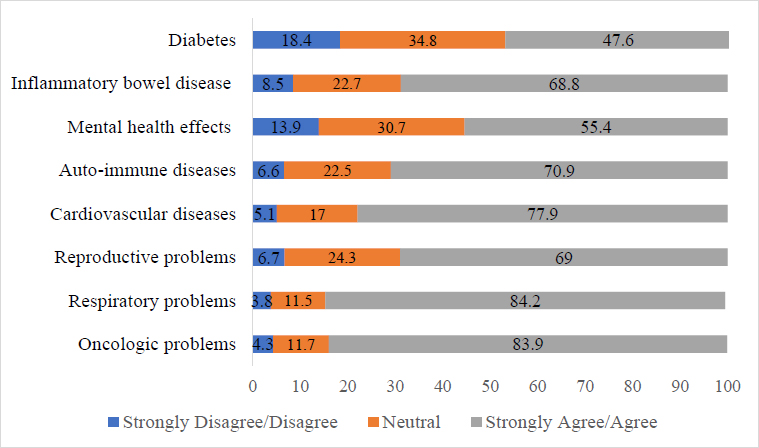
Perceived impact of plastic pollution on human health and conditions among participants (N=511).
3.4. Perceived Seriousness about the Impact of Plastic Pollution on Society
More than half of the students perceived the impact of plastic pollution on various societal problems as serious (Fig. 2). While the majority were concerned about the impact of plastic on society in the form of water pollution (67.9%) and pollution of the marine environment (61.8%), the least concern was expressed regarding the impact of plastic on local ecology.
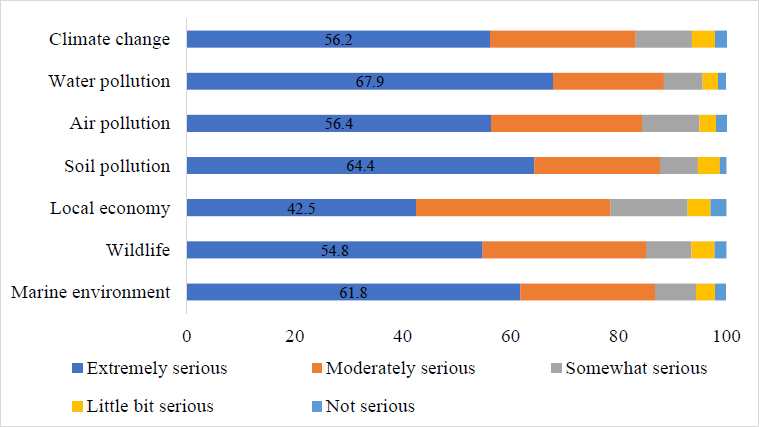
Perceived seriousness about the impact of plastic pollution on society among participants (N=511).
Figure 3 illustrates the overall perception of undergraduate nursing students regarding the impact of plastic pollution on human health and society. The results indicate that most participants perceived the societal impacts of plastic pollution to be more severe than its effects on individual health.
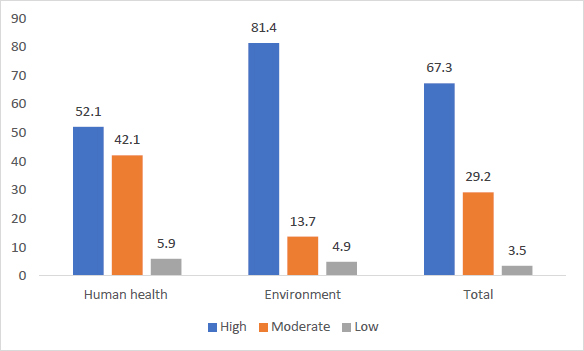
Perceived impact of plastic pollution on human health and society among participants (N=511).
Table 3 presents the Pearson correlation coefficients to assess the linear relationships among four variables: age, behavior, perceived impact of plastic pollution on human health and conditions, and perceived seriousness of the impact of plastic pollution on society among study participants. Table 3 shows that there was no significant correlation between age and behaviors, perceived impact on human health, or perceived seriousness of plastic pollution (p > 0.05). However, behaviors were positively and significantly correlated with both perceived impact on human health (r = 0.121, p = 0.006) and perceived seriousness (r = 0.100, p = 0.024). A strong positive correlation was observed between perceived impact on human health and perceived seriousness (r = 0.420, p < .001). No statistically significant difference was observed in students’ perceptions (χ2-63.614, p = 0.823) and behaviors (χ2-82.498, p = 0.617) across years of study.
| - | Age | Behaviours | Perceived Impact on Human Health | Perceived Seriousness | |
|---|---|---|---|---|---|
| Behaviours | Pearson Correlation | 0.036 | 1 | - | - |
| Sig. (2-tailed) | 0.421 | - | - | - | |
| Perceived impact on human health | Pearson Correlation | 0.023 | 0.121** | 1 | - |
| Sig. (2-tailed) | 0.598 | 0.006 | - | - | |
| Perceived seriousness | Pearson Correlation | 0.033 | 0.100* | 0.420** | 1 |
| Sig. (2-tailed) | 0.450 | 0.024 | 0.000 | - | |
Note: **. Correlation is significant at the 0.01 level (2-tailed).
*. Correlation is significant at the 0.05 level (2-tailed).
The regression model was statistically significant, F(2, 508) = 4.567, p = 0.011, as shown in Table 4, although it explained a small proportion of the variance in plastic-use-related behavior (R2 = 0.018). As shown in Table 5, the perceived impact of plastic pollution on human health was a significant positive predictor of behavior (B = 0.032, p = 0.048), suggesting that greater concern about health impacts was associated with more environmentally responsible behaviors.
| ANOVA | Sum of Squares | Df | Mean Square | F | P-value |
|---|---|---|---|---|---|
| Regression | 0.467 | 2 | 0.233 | 4.567 | 0.011 |
| Residual | 25.962 | 508 | 0.051 | - | - |
| Total | 26.429 | 510 | - | - | - |
| Predictor | B | Std. Error | Beta | t | P-value |
|---|---|---|---|---|---|
| (Constant) | 0.964 | 0.071 | — | 13.594 | 0 |
| Perceived impact of plastic pollution on human health and conditions | 0.032 | 0.016 | 0.096 | 1.986 | 0.048* |
| perceived seriousness about the impact of plastic pollution on society | 0.019 | 0.015 | 0.06 | 1.233 | 0.218 |
Note: *significant at p < 0.05.
However, the perceived seriousness of the societal impact of plastic pollution did not significantly predict behavior (B = 0.019, p = 0.218). The model explained 1.8% of the variance in behavior (R2 = 0.018), which represents a small effect size according to Cohen's guidelines.
4. DISCUSSION
This study explored the current pattern of plastic product consumption and the perceived impact of plastic pollution on human health and the environment among Indian nursing students. Most students perceived the impact of plastic pollution on human health and the environment to be moderate to high. Positive environmental behavior showed a significant, though modest, correlation with perceived health impacts of plastic pollution, indicating that students with better practices were more likely to engage in plastic pollution-related preventive behaviors. However, significant gaps persist, as more than one-third of the participants were unaware of the difference between biodegradable and recyclable plastics, and the majority had not attended seminars or workshops on plastic pollution, indicating limited formal exposure to awareness-building initiatives.
The study observed that more than one-third of the participants used single-use plastic products daily. The findings are consistent with those of previous studies on plastic use patterns in India and other countries (Bakhtari Aghdam et al., 2019; Coco Chin et al., 2023; Duraisamy et al., 2023; Hassan et al., 2023). In an earlier study of nursing students in the United Arab Emirates, the daily use of plastic, including bottled water and plastic bags, was found to be 65.7% among participants (Ravi et al., 2024b). Another study among Indian adults found that 92% of participants used plastics in their daily routines. The study reported convenience, availability, and cost-effectiveness as significant reasons for plastic use among the participants (Duraisamy et al., 2023). A relatively similar use of plastic items was reported among adults in Egypt, with 77.1% of participants using plastic products frequently and occasionally. The study found that being lightweight and readily available were the most common reasons for their use (Hassan et al., 2023). Another study from Europe reported that 63.8% of participants used plastic daily, mostly through packaging and plastic bags. Owing to their affordability, durability, and lightweight nature, plastic products are extensively used and disposed of (Barbir et al., 2021; Haba et al., 2025).
Most participants were aware of biodegradable plastics and understood the difference between biodegradable and recyclable plastics, as reported in earlier studies (Filho et al., 2021). Bio-based plastics have been suggested as alternatives to conventional plastics, which can help minimize the impact of plastic pollution (Al-Khairy et al., 2022). Carry bags made of bio-based plastics have been introduced in the market as an alternative to petroleum-based plastics, and the minimum thickness restriction of 50 μm is waived under the 2016 Plastic Waste Management (PWM) Rules in India, which incentivizes the usage of compostable carry bags and items (Nøklebye et al., 2023).
In humans, the invasion of plastic debris in the form of macro-, micro-, and nanoplastics has been shown to alter the functioning of the endocrine, immune, and nervous systems (Fadare et al., 2020; Teles et al., 2020). Health consequences such as thyroid gland dysfunction, diabetes, and dysfunctional reproductive systems have been attributed to the invasion of plastic products into the body (Fadare et al., 2020; Teles et al., 2020). Most students agreed on the detrimental effects of plastic pollution on human health, with strong associations with respiratory and oncological problems. This contradicts the results of an earlier study among nursing students, in which only 5.2% of participants reported high perceived health threats from plastic pollution (Ravi et al., 2024b). Most students perceived a greater health impact of plastic exposure on the respiratory system and through genotoxic mechanisms leading to oncological conditions; however, they perceived the impact of plastic pollution on diabetes and mental health disorders to be low. These findings align with those of an earlier study that reported a higher perception of oncological and respiratory problems associated with plastics among nursing students (Ravi et al., 2024b).
The students reported a greater impact of plastic pollution on the environment than on human health, with the majority reporting its effects on the marine environment, air pollution, and climate change. These findings contradict reports from the United Arab Emirates, where nursing students reported greater health impacts than those on the bio-ecological environment (Ravi et al., 2024b). Similarly, European adults perceived soil and air pollution and climate change as not extremely serious environmental threats to plastics (Filho et al., 2021). Emerging research and media coverage on plastic pollution in marine habitats is available. This fact can be attributed to the higher perceived impact of environmental threats on the marine environment (Thushari and Senevirathna, 2020; Yu and Singh, 2023).
The study found that over one-third of the participants lacked awareness of biodegradable and recyclable plastics. This reflects the strong need for awareness and educational interventions regarding the adverse consequences of conventional plastics and the importance of biodegradable and greener plastic products. The literature has documented the effectiveness of educational interventions in raising awareness and fostering attitudinal changes in the use and subsequent handling of plastic products (de Sousa, 2023; Skoric et al., 2022). Previous studies have suggested that sociodemographic factors strongly influence plastic use behaviors and attitudes. For instance, younger adults and individuals with a university education or higher have been reported to exhibit lower plastic usage and more favorable attitudes toward the environmental and health impacts of plastic consumption (Filho et al., 2021). In contrast, Duraisamy et al. found that individuals younger than 40 years and those without formal education were associated with lower plastic usage; however, their study also noted higher plastic consumption among non-agriculturists and urban residents than among rural inhabitants (Duraisamy et al., 2023). Similarly, a study from Malaysia by Chin et al. demonstrated that participants aged 31–45 years showed greater willingness and more positive attitudes toward plastic waste segregation, recycling, reuse, and participation in awareness campaigns than younger age groups (Coco Chin et al., 2023).
Notably, nearly half of the participants expressed little to no effort to reduce plastic use in their daily lives. This is concurrent with a study from Ethiopia, where 39.4% of participants insisted on continuing to use plastic materials, such as bags, despite knowing their harmful effects on health and the environment (Misgana and Tucho, 2022). Lack of alternatives, insufficient information on bioplastics, availability issues, and higher prices of alternative products are some of the factors reported to impede measures to curb regular plastic use (Filho et al., 2021; Misgana and Tucho, 2022). Raising awareness and strict law enforcement can strengthen plastic waste management; for example, segregating used plastics can also curb plastic use (Bakhtari Aghdam et al., 2019; Ergen et al., 2015).
In the present study, a significant positive correlation emerged between perceptions of plastic pollution's impact on human health and engagement in participatory or environmentally responsible behaviors, suggesting that individuals who believe plastic pollution negatively affects human health are more likely to engage in such behaviors. Similarly, a weaker but statistically significant association was found between behavior and perceived seriousness of plastic pollution’s societal impact, indicating that social concern may also play a motivational role, albeit to a lesser extent than environmental concern. The strongest correlation in the matrix was between perceived health impact and perceived seriousness, reflecting a conceptual overlap: individuals who perceive personal health threats may simultaneously view the issue as socially serious.
Regression analysis clarified the unique contributions of these predictors. The perceived impact of plastic pollution on human health remained a significant predictor of behavior, whereas perceived seriousness did not. This implies that concerns about personal health may be a more immediate motivator for behavior change than broader societal concerns. A study conducted in Portugal mirrored similar findings, with hierarchical regression models showing that perceived health-related impacts were strong predictors of pro-environmental behaviors (Soares et al., 2021). However, although the regression model was statistically significant, its very small explanatory power (R2 = 0.018) indicates that the included predictors account for only a minimal proportion of the variance in plastic-use behavior, suggesting that other unmeasured psychological, social, and environmental factors likely play a more substantial role, which should be acknowledged as a key limitation and explored in future research. This finding aligns with the international literature, which shows that environmental and health risk perceptions are not always translated into pro-environmental or plastic reduction behaviors, and often account for only a small proportion of behavioral variance (Janmaimool et al., 2024; Little et al., 2023). Similarly, a study conducted in India found that despite adequate awareness, plastic consumption behaviors persist due to convenience, limited infrastructure, and insufficient institutional reinforcement (Duraisamy et al., 2023). These findings are consistent with behavioral frameworks such as Protection Motivation Theory, suggesting that while perceived risk is important, additional factors, such as self-efficacy, environmental support, and enabling conditions, are necessary to drive a sustained reduction in plastic consumption (Little et al., 2023).
5. IMPLICATIONS
There is a need for coordinated efforts across education, healthcare practices, and policies to translate awareness of plastic pollution into sustained behavioral and societal changes. The findings imply that nursing education should strengthen and continuously integrate environmental health and sustainability content across all years of study to enhance students’ awareness and promote meaningful behavioral change. This should be complemented by targeted academic and co-curricular initiatives, such as seminars and workshops, to address specific knowledge gaps, including the distinction between biodegradable and recyclable plastics. Furthermore, enhancing students’ understanding of sustainable alternatives, such as biodegradable and bio-based materials (e.g., nanocellulose, chitin, and lignin-based plastics), is crucial.
Healthcare professionals are in a key position to raise awareness of the direct and indirect effects of plastic pollution on human health and the environment, and nursing students can be the ‘change agents’ for this positive behavioral change among the public regarding plastic usage and its treatment. Nursing students should be given the opportunity to participate in voluntary activities in collaboration with local and state-level organizations to raise awareness of the negative impacts of plastic pollution and to promote environmentally friendly, sustainable alternatives.
Advocacy is needed to integrate plastic pollution education and mitigation strategies into national health and environmental policies, aligning them with global sustainability goals. Strengthening the enforcement of plastic waste management regulations and promoting comprehensive strategies, such as reducing, reusing, recycling, recovering, and responsible disposal, are essential. Additionally, engaging healthcare professionals in policy processes and incentivizing the development and adoption of biodegradable and bio-based alternatives can further enhance effective plastic waste reduction and management strategies.
6. LIMITATIONS AND STRENGTHS
The findings of this study must be interpreted in light of its limitations. First, the study incorporated data from only two academic institutes in a diverse country such as India, limiting the generalizability of its findings. The data collection was cross-sectional, and follow-up information on the perception of plastic pollution among nursing students over time could not be obtained. The sample size was comparatively small to reflect the perceptions of nursing students in a densely populated country such as India. Finally, the study relied on participants' self-reported data to reflect their behavior regarding plastic use and consumption, which may introduce social desirability bias. However, the strength of this study is its multicentric design, which incorporates data from nursing students at two premier public-sector health universities in India.
CONCLUSION
Plastic pollution and its lasting health and environmental impacts are growing global public health concerns. Although most participants agreed that plastic pollution has health effects, nearly one-third reported daily use of plastic products. Most participants reported convenience and the lack of cost as the primary reasons for their use, and nearly half made little or no effort to reduce their use of plastic items in their everyday lives. Most students perceived plastic pollution as having a high impact on the environment and human health. Nursing students reported that water pollution and pollution of the marine environment were significant environmental impacts of plastic pollution. Nurses, the largest group of healthcare professionals, can play a key role in raising awareness about plastics and their lasting health and environmental impacts. This study reiterates the need to strengthen the knowledge base on the detrimental effects of plastic pollution and on available sustainable alternatives among budding nurses to positively impact behavioral change among the public and mitigate the rising crisis caused by plastic waste.
Improved governance of plastic waste management through public policy, including the participation of healthcare professionals in various efforts to raise awareness, can bring about changes in Indian society.
AUTHORS’ CONTRIBUTIONS
The authors confirm contribution to the paper as follows: R.K.R., P.B., and B.P.: Conceptualization, data curation, methodology, investigation, formal analysis, writing -original draft, conceptualization, data curation, methodology, investigation, and original draft; R.V.R.: Investigation and writing - review and editing; A.U.R.R. and P.B.: Data analysis and interpretation; S.P. and S.A.: Review and editing, resources, and supervision. All authors reviewed the results and approved the final version of the manuscript.
LIST OF ABBREVIATIONS
| CVI | = Content Validity Index |
| HDPE | = High-Density Polyethylene |
| PET | = Polyethylene Terephthalate |
| PMT | = Protection Motivation Theory |
| PWM | = Plastic Waste Management |
| SPSS | = Statistical Package for the Social Sciences |
ETHICS APPROVAL AND CONSENT TO PARTICIPATE
The Internal Ethics and Research Review Committee of the National Institute of Mental Health and Neurosciences College of Nursing, Bangalore, South India City, India (NIMH/CON/SEC/12-23) and the Ethics Committee of Saraswathi Professional and Higher Educational, College of Nursing, Ludhiana City, India (IEC/SPHE/N/2023/131, Date 21/08/2022) reviewed and approved the study protocol.
HUMAN AND ANIMAL RIGHTS
All human research procedures followed were in accordance with the ethical standards of the committee responsible for human experimentation (institutional and national), and with the Helsinki Declaration of 1975, as revised in 2013.
CONSENT FOR PUBLICATION
After explaining the purpose and nature of the study, written informed consent was obtained from all participants involved in the study.
AVAILABILITY OF DATA AND MATERIALS
The datasets generated and/or analysed during the current study are available from the corresponding author [R.K.R] upon reasonable request.
ACKNOWLEDGEMENTS
The authors are grateful to all the study participants for their valuable time and contributions and to the institutional administrators for granting permission to conduct the study.

