All published articles of this journal are available on ScienceDirect.

Building Resilience to Environmental Vulnerabilities: Insights into Communication Gaps in Contexts of Extreme Precipitation

Abstract
Introduction
Effective communication is pivotal in environmental management, particularly in strengthening community resilience to climate-related vulnerabilities. Communication is understood not merely as the exchange of information, but as a nuanced process shaped by environmental, social, cultural, and institutional dimensions. This study analyzes three international case studies to assess how communication strategies influence resilience outcomes.
Methods
A qualitative approach guided the selection of case studies, based on four criteria: (1) relevance to cross-sectoral communication, (2) diversity of stakeholder involvement, (3) availability of triangulated data from academic literature, media sources, and firsthand narratives, and (4) potential to derive broadly applicable insights.
Results
Drawing from longstanding research in science communication and insights from the case studies, the study proposes a structured framework comprising five interrelated pillars: Co-creation, Redundancy, Trust-building, Contextualized messaging, and Feedback integration. This model is intended to support the practical implementation of communication strategies across diverse scenarios.
Discussion
Findings confirm that effective communication transcends information delivery, functioning as a cognitive process embedded in environmental, social, cultural, and institutional contexts. Recurring challenges, such as breakdowns in communication and governance limitations, are identified, alongside innovative practices, such as gaming, creative activities, and dialogues among researchers and civil society, which have proven effective in specific contexts.
Conclusion
The study concludes by emphasizing the importance of integrating qualitative insights and contextual sensitivity to inform communication strategies that effectively foster environmental resilience. It underscores the need for inclusive, interdisciplinary approaches and suggests integrating communication training across academic and professional fields.
1. INTRODUCTION
Although communication challenges in environmental risk management have been explored for decades, translating communication strategies into actionable, site-specific practices in the context of extreme precipitation events remains fragmented. This study aims to contribute to bridging that gap by synthesizing evidence from three distinct case studies, providing grounded insight into communication breakdowns and innovations during climate-related emergencies. The goal is not only to reinforce known principles but to contextualize them, highlighting actionable pathways for improved practice in diverse cultural and institutional environments.
In this work, communication is understood not only as information exchange but also as a cognitive process that integrates environmental, social, cultural, and institutional factors (Kotova et al., 2022; van der Horst et al., 2023). It encompasses how people perceive, interpret, and act on environmental information within their specific contexts - shaped by previous experiences, belief systems, and power structures (Muller et al., 2024; Wiréhn and Strandberg, 2025). This broader understanding is essential to understanding why communication succeeds or fails in building resilience.
Information and relevant knowledge about rainfall scenarios and vulnerabilities are needed to take the best actions at the right time (Burrowsa et al., 2022; Catsadorakis et al., 2022; Mohr et al., 2022; Wen et al., 2023). However, this knowledge, by itself, has been shown to be insufficient. Society needs to shift from a paradigm centered exclusively on research and data to a comprehensive integration of all the environmental, social, and human dimensions that play a role in the context of extreme climate events (Freitas et al., 2017; Freitas et al., 2018; Raju et al., 2023; Klenk, 2018).
Communities of commercial fishermen in New England reported a lack of trust in dealing with scientists; one reason was that fishermen’s knowledge was not accepted as valid or equal to scientists’ knowledge, which represented a barrier to information sharing among them (Hartley and Robertson, 2008).
Interestingly, peer-reviewed literature demonstrated that communication issues are addressed across a wide range of scientific fields and activities, and is highly rated for its impact on learning and teaching, on professional efficiency, on the success of a business, on minimizing risks to people and infrastructures, and on the performance of organisations and enterprises, among others (Altabbaaa et al., 2019; Amoah et al., 2019; Beghetto and Madison, 2022; Besley and Dudo, 2022; Braslauskas, 2021; Brynielsson et al., 2017; Granek et al., 2017; Holmesa et al., 2018; Illingworth, 2020; Kwame and Petrucka, 2021; O’Connor et al., 2023; Salam et al., 2022; Wangari et al., 2019; Weingart and Joubert, 2019).
Through communication, socio-cultural structures (e.g., beliefs and values), background knowledge, previous experiences, and individual perceptions are expressed. To address global societal and environmental challenges, such as extreme precipitation events, researchers use concepts and frameworks, use technical language, and prioritize issues and goals that differ from those of non-researchers. Research semantics differs from everyday language, and one barrier to practitioners, populations, or journalists understanding researchers is precisely language (Young, 2014; Weitkamp et al., 2023). For instance, the word “uncertainty” is often heard by non-scientists as meaning scientists are unsure of the scientific facts, whereas to scientists it refers to the level of confidence in data (Young, 2014). “Uncertainty” is widely used in the context of projections of climate scenarios and extreme events, such as droughts, floods, and hurricanes. Contributions that address communication challenges, particularly when pain and death are involved, and when pressure, expectations, and resources must be carefully managed, are primarily found in literature focused on hospital settings (Altabbaaa et al., 2019; Amoah et al., 2019; Granek et al., 2017; and Kwame and Petrucka, 2021).
Communication has long been recognized as critical for success in professional, organizational, and scientific settings. Its role in risk reduction and resilience-building is particularly emphasized in environmental contexts, especially during emergencies. Rather than reiterate established general knowledge about communication, this work emphasizes cross-disciplinary literature and evidence that addresses communication challenges in climate-related disasters. Several publications (e.g., Vaughan and Dessai, 2014) have explored frameworks for integrating climate information into decision-making. Additionally, Briley et al. (2015) discussed how co-production of knowledge between scientists and stakeholders enhances resilience. These studies reinforce the importance of tailored, multi-actor communication strategies aligned with local knowledge and needs.
Precipitation, especially heavy precipitation, is a challenging research topic (Ludwig et al., 2023), and resilience to future precipitation risks requires wisely informing all actors. Science communication needs to promote two-way communication that informs about research and co-creates new knowledge (Illingworth, 2020). The need to develop better communication and dissemination processes, considering the specific context of different actors in climate change adaptation, was one of the practice gaps identified by Leitner et al. (2019).
Researchers, decision-makers, stakeholders, and populations need to share information and collaborate to increase resilience to precipitation extremes. The motivation to analyze the role of communication in extreme climate contexts and events arose from observations made during interactions and collaborations with a wide range of audiences, addressing water and environmental challenges.
The objective of this work is to gather, organize, and analyze information to support understanding the impact of communication dimensions. It aims to bring innovative insights and to contribute to the removal of silos between environmental, engineering, and social sciences, as well as between knowledge and practice.
2. MATERIALS AND METHODS
Case study selection followed a qualitative approach with four criteria: (1) cross-sector communication relevance, (2) diversity of actors, (3) availability of triangulated data from literature, media, and firsthand accounts, and (4) potential for generalizable lessons. Triangulated data, in this context, refers to the combination of different types of evidence, including peer-reviewed research, media reports, and direct stakeholder testimonies. This approach improves the reliability of the case study findings by cross-validating observations from independent and complementary sources. Data sources included peer-reviewed papers, official project reports, media archives, and direct accounts. Personal communications were used only when other documentation was unavailable, and their limitations are acknowledged as subjective but contextually rich evidence.
Based on the criteria, three case studies were selected. The information and data that support the description and analysis of each case are the following:
(1) The 2021 Flooding Event in the Ahr River Basin, Germany. Data were gathered from media reports, personal communications, and accounts from local families who directly experienced the event, complemented by evidence from peer-reviewed scientific literature.
(2) Outcomes from the Communities of Practice (CoPs) established in six countries under the research project BINGO-Bringing INnovation to onGOing Water Management - A better future under climate change, along with the organization of an event in Portugal aimed at informing civil society about possible local impacts from climate extremes. The information used includes project reports, their results, and peer-reviewed publications. All participants in the CoP activities provided informed consent, and no personnel data was collected, in accordance with the project's ethics guidelines.
(3) Droughts and risk management in the transboundary Prespa Lakes region. Based on media news, information from the Society for the Protection of Prespa (SPP), peer-reviewed papers, and a preliminary analysis of the requirements for a tool to support risk decision-making in the region.
A cross-cutting analysis of the three selected cases was subsequently conducted to support the development of a structured communication framework aimed at enhancing resilience to extreme precipitation events.
3. RESULTS
3.1. Exploring Communication and Resilience in the Context of Extreme Precipitation: Three Case Studies
3.1.1. The 2021 Flood in the Ahr River Basin (Germany)
In July 2021, severe flooding devastated Germany, Luxembourg, Belgium, and the Netherlands, with a dramatic impact on society, the economy, the environment, and morality. It was one of the five heaviest precipitation events in Germany over the past 70 years (Ludwig et al., 2023). The case of the Ahr River basin in Bad Neuenahr-Ahrweiler, Germany, raises awareness of the requirements for building flood resilience and of on-site-specific communication challenges during emergencies.
The Ahr River has a catchment area of approximately 900 km2 and flows into the Rhine. The sharply carved topography of the Ahr valley pushed populated settlements toward the river and left few floodplains for safe flooding. Two severe past floods occurred in 1804 and 1910 (Roggenkamp and Herget, 2014).
The 2021 flood event was dramatic, with almost four hundred people losing their lives. The water levels in the headwaters of the river began to rise on the morning of 14th July (08:00-10:00 UTC). In 12 hours, the water rose by more than 5 meters, reaching maximum levels in the evening. The steepness and reduced flow section of the Ahr River resulted in high flow velocities, erosion, and the transport of floating debris, which caused blockages and increased flow heights due to gullying. As a result, the villages along the riverbed were severely affected by the flood, resulting in many deaths and extensive infrastructure damage (Mohr et al., 2022).
Information about how the local inhabitants experienced the flood event was obtained through dialogues with several families. While not statistically representative, these narratives provided insight into risk perception and communication effectiveness. A major issue was the lack of actionable information in the early hours of the event. Initial alerts did not convey the true severity, leading many to stay indoors, unaware of rising water levels. The failure of digital alerts due to infrastructure damage highlights the need for redundant systems. Traditional methods, like sirens and church bells, locally trusted and not reliant on power or network infrastructure, emerged as crucial components in risk communication plans.
The Ahr valley is a sensitive area due to the steep terrain, and the cumulative effects of extreme events suggest a heightened hazard potential under climate change scenarios. It is known that land use changes the formation of flooding events, but in this case, the flood peaks of 2021 are comparable to those from the historical events of 1804 and 1910, which were not included in the flood risk assessment (Ludwig et al., 2023).
This case illustrates how important it is to manage clear, actionable communication of information (UNDRR 2023) and to integrate and update research outcomes into decision-making and contingency planning. To better protect the population, non-technological forms of communication should be included in alert plans, since infrastructure damage may disable communication channels. Traditional and site-specific alert methods, such as setting off a siren or ringing the church bell, are options to consider alongside more sophisticated, technologically supported options.
3.1.2. Communities of Practice and Public Events to Engage Stakeholders in Extreme Events Preparedness: Outcomes from the Research Project Bingo
The European Union-funded H2020 BINGO project, Bringing INnovation to onGOing Water Management - A better future under climate change, aimed to generate and provide knowledge and tools for water managers, decision-makers, and politicians. It focused on delivering practical solutions for six case studies across Europe, namely Norway, Germany, the Netherlands, Portugal, Spain, and Cyprus. The research cases comprised distinct climate, cultural, and socio-economic contexts, as well as distinct vulnerabilities to floods and water scarcity. The availability of water for consumption, agriculture, tourism, ecosystem maintenance, and the risks of flooding to the urban population were addressed by the research.
Communities of Practice (CoPs) were established in the six countries, dedicated to addressing precipitation extremes. A total of 25 workshops, engaging 557 participants from different sectors, took place over the four years of the project duration, according to a roadmap (Freitas et al., 2017). Communication in the national language of each country was used in all CoPs. Stakeholders' preferences regarding communication media were also respected. For example, most farmers and community leaders in Cyprus were older than 65, preferring face-to-face communication and receiving paper materials, unlike other communities that were comfortable with digital media and receiving technical information, as was the case, for example, in the agricultural sector in Lezíria do Tejo, Portugal.
Interestingly, one of the biggest barriers identified was the difficulty in translating scientific knowledge into practice. Participants highlighted that while technical information was available, it was often inaccessible or not actionable because it was communicated poorly. Governance-related issues, such as a lack of institutional coordination, inconsistent messaging from authorities, and unclear jurisdictional responsibilities, further complicated communication (Muthanna et al., 2019). To overcome these barriers, some project researchers engaged in communication training. This enabled the project to implement more innovative and inclusive forms of communication, including acting aimed at the scientific and technical community, and using dance and gaming to communicate with civil society (Barbosa and Matos, 2017; Matos et al., 2019).
In March 2019, an event was organized at the Tagus River estuary to provide families and local decision-makers with information about the water cycle and potential changes under future climate. The program included several events, music, talks, guided tours, games, and prizes. (Fig. 1) shows participants walking near the marker of a historically significant local flood, illustrating the area's vulnerability to extreme precipitation events.
The one-day event was attended by around 30 people, ranging in age from children to 70-year-olds. The 28 responses to the event evaluation questionnaire (on a 5-point scale) indicated that the communication strategy was successful, namely: very positive (22 responses), positive (5 responses), and average (1 response). Dance and other creative activities are known to enhance communication (Burrowsa et al., 2022; Illingworth, 2020), which helps explain the event's positive impact. The experience was also successful in engaging the local decision-makers (the Mayor and the President of the parish council) in joint activities with researchers, local stakeholders, and families.
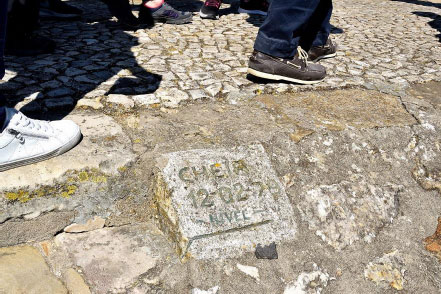
On-site mark of a historical flood from 12.02.1978, at the banks of the Tagus River estuary. Photo by João Craveiro (2019).
In general, the oral and written comments received from the participants were well aligned with conclusions by O'Connor et al. (2023) and Kotova et al. (2022) on the relevance of creating opportunities, in differentiated settings, where civil society, including youngsters and children, can get access to information and be able to speak directly to researchers and experts.
During the four years of implementing the project activities, it was observed that the researchers on the team, from all countries, were inspired to learn new communication processes, overcoming discomfort with new approaches and with diverse audiences.
3.1.3. The Transboundary Prespa Lakes Territory and the Management of Drought Risks
The catchment area of the Prespa and Ohrid lakes, commonly referred to as the Prespa lakes, is shared by Greece, Albania, and North Macedonia c.f., (Fig. 2). This 1300 km2 watershed is a region of great ecological and cultural value, with primarily rural characteristics and tourism-related services. It has European and international recognition of natural values, including three Ramsar sites, and various national protected areas (Catsadorakis et al., 2022; SPP, 2023). Among the region’s rare biodiversity values are water birds, such as Dalmatian pelicans. Additionally, cultural heritage, including Byzantine and post-Byzantine monuments, also requires protection (Popov et al., 2007; UNESCO, 2023; Vanderplanken et al., 2021).
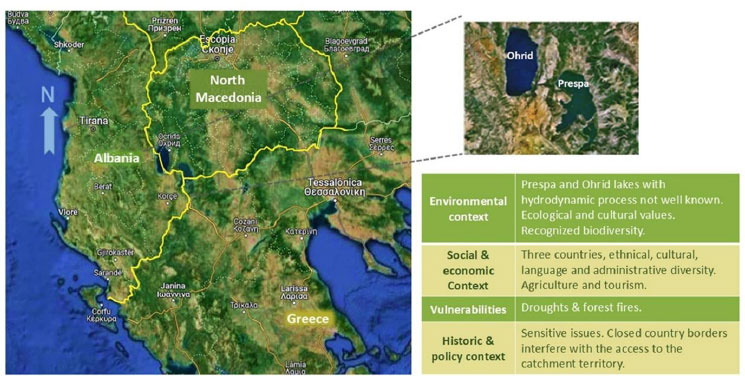
The transboundary Prespa Lakes territory and its multiple challenges.
The region is affected by prolonged droughts and, consequently, is at risk of forest fires. Moreover, researchers acknowledge the need to better understand the hydrological processes in the lakes, particularly the hydraulic connection between Prespa and Ohrid, and the combined factors contributing to the decline in water levels (Popov et al., 2007). These hazards not only have an environmental impact but also have very negative socio-economic effects on the region's most important activities, agriculture and tourism (Grazhdani, 2023; SPP, 2023).
The first coordinated effort to protect the area began in 1990 with the founding of the Society for the Protection of Prespa (SPP). This organization promotes the resilience of the territory, protecting biodiversity, the population, and economic activities. The spatial scale of the catchment, coupled with the cross-border dimension and sensitive historical, political, and cultural issues, adds complexity to establishing vulnerability and risk indicators and to launching a coordinated governance strategy to support management of the response to extreme climate events (Bogdanovic, 2008; Catsadorakis et al., 2022; Grazhdani, 2023; SPP, 2023).
During a preliminary analysis of the requirements for a tool to support decision-making in the region regarding the management of droughts and fires, researchers working with the SPP identified communication challenges in developing effective decision-support platforms to ensure coordination of multi-risk management among the various players across the three countries.
Governance and cross-border collaboration can only be achieved if communication issues among all actors and sectors from Greece, Albania, and North Macedonia are overcome. All collaborative efforts to pursue this ambition must integrate geographical, ethnic, cultural, linguistic, and administrative diversity, as well as consider political and historical sensitivities in the context of relations between countries. Managing conflicts over natural resources depends on effective communication designed to build trust among stakeholders (Kling et al., 2019), and when communication is ineffective and transparent, collaboration barriers remain in place (Li et al., 2022).
Noteworthy, communication and cooperation must be enhanced at all levels, comprising local municipalities, sectors of stakeholders, such as fishermen, farmers, NGO, ENV-NGO, and others, in order to accomplish common goals of environment and biodiversity preservation, as well as the protection of the territory from natural disasters, including research on regional hydrological processes (Bogdanovic, 2008; Popov et al., 2007).
3.2. Case Study Insights and the Design of a Disaster Communication Framework
The three examples displayed distinct scales of knowledge and data, processes in place, and communication challenges. In all cases, the importance of addressing stakeholders’ and communities’ needs and preferences, regarding language, communication channels, and forms of interaction, was unquestionable.
During the workshops at the six CoPs established by the BINGO project, it was recognized that alliances among stakeholders and researchers are important, and that communication with civil society and decision-makers must be consistent and suited to the purpose. Additionally, all CoPs recognized that inappropriate information and communication were obstacles to placing existing knowledge into practice. Removing this barrier alone would significantly enhance the resilience of both the sites and their populations. This conclusion is supported by the events in Bad Neuenahr-Ahrweiler, where existing data and historical information were not taken into account. Risk assessments and effective communication among the various actors failed.
Disaster risk management also requires a detailed definition of roles and responsibilities, and structured collaboration among stakeholders (Vanderplanken et al., 2021). Historic facts and previous events should be used to enhance public awareness (Raju et al., 2023; Mhor et al., 2022), and decision-makers should make use of this data.
Based on the analysis of the three cases, this work proposes a structured communication framework for disaster resilience. The framework includes five interlinked pillars, which are as follows:
• Co-creation: engaging stakeholders early to shape context-relevant messaging;
• Redundancy: combining digital and analog systems to maintain communication during infrastructure failure;
• Trust-building: investing in long-term relationships with communities beyond crisis events;
• Contextualized messaging: using appropriate language, visuals, and media formats tailored to audience characteristics;
• Feedback integration: creating mechanisms for continuous learning, evaluation, and message refinement.
This framework is intended to support both planning and real-time response, especially in multi-stakeholder, culturally diverse contexts.
4. DISCUSSION
The reported examples demonstrate that effective resilience to extreme weather depends on clear and actionable communication of information, recognition of local and regional characteristics, past records, and the needs and preferences of affected communities (Catsadorakis et al., 2022; Freitas et al., 2017; Roggenkamp and Herget, 2014; Raju et al., 2023). They also highlight that failures in preparedness and communication can result in severe fatalities (Mohr et al., 2022).
Communication about extreme precipitation events under climate change scenarios often provokes responses based on the assumption that these events are inevitable disasters. Inappropriate communication of future risks can trigger reactions that undermine population preparedness. Therefore, the selection of communication strategies must be deliberate, ensuring that information is effectively received and understood by the target audience. Communication techniques and channels are critical; the larger the group of stakeholders, the more complex it becomes to address communication challenges and barriers (Hartley and Robertson, 2008; Li et al., 2022), as demonstrated in the transboundary Prespa basin.
The use of modern technologies facilitates knowledge sharing among stakeholders (Chaudhuri et al., 2023). The advantages of an increasingly digital society, as well as the value of information disseminated through social media, are particularly relevant in the context of extreme precipitation events (Brynielsson et al., 2017; Mohr et al., 2022). Many authors focus their discussions on technology-mediated communication (Clement et al., 2022; Batool et al., 2023; Beghetto et al., 2022). However, a mature society must carefully consider both the benefits and limitations of technology-mediated communication (Berry, 2006; Hassell and Cotton, 2017), including issues of social justice and inclusiveness, since not everyone is able or willing to engage through digital means. Findings from the BINGO project activities highlighted the importance of face-to-face interactions between researchers, stakeholders, and civil society, demonstrating the continued value of direct, personal communication.
Technology must not undermine the value of human resources and interactions, such as face-to-face communication and connecting through joint activities (Godtman Kling et al., 2019). Moreover, people may have individual conditions that affect their ability to access information through certain media, and during disasters, infrastructure damage may interfere with the use of technology-mediated communication.
Communities potentially affected by extreme climate events should be able to understand the local hazards (Raju et al., 2023). The BINGO project event held at the Tagus River estuary established a direct connection to the territory, its needs, and associated risks, while providing an active link to research findings on potential future climate extremes.
It is plausible that scientists may have “communication advisors” to support science and risk communication (Besley and Dudo, 2022) or that communication facilitators should support processes to build collaboration among stakeholders (Petersen et al., 2002; Godtman Kling et al., 2019). It is unquestionable that communication is a relevant tool (Godtman Kling et al., 2019) and a key resource for managing critical environmental challenges. Face-to-face meetings enhance relationships and confidence among diverse stakeholders, support better information access, and lay the foundation for action (Muthanna et al., 2019).
5. STUDY LIMITATIONS
This study is primarily qualitative, based on selected case studies, and provides limited statistical validation. Personal communications, while rich in contextual insights, lack the rigor of formal surveys. The sample size was not predetermined using quantitative criteria, as the purpose was illustrative rather than inferential. Future research may benefit from integrating formal sampling methods and mixed-method approaches to further validate the observed communication patterns.
CONCLUSION
Society faces the challenge and opportunity to develop more inclusive approaches to resilience, and one catalyst is addressing communication as an elementary tool. Building resilience not only to climate extremes but also to natural hazards requires holistic approaches that bring together interconnections from the natural and social sciences and governance factors. This work highlighted communication features and challenges emerging in multidimensional environmental frameworks.
Resilience is an ongoing process that helps communities and stakeholders become more capable of making the best decisions. Although the examples from this study concern precipitation extremes, the lessons learnt apply to other situations. Improving societal resilience to environmental vulnerabilities is connected to acknowledging communication as a relevant tool. Moreover, there are proven links among communication, creativity, decision-making, and the effectiveness of problem-solving (e.g., Lilly and Bramwell-Rejskind, 2011; Roystone and Reiter-Palmon, 2017; Velez et al., 2022), all of which are most needed to tackle current global environmental challenges. Introducing subjects on technical and professional communication for diverse audiences into academic education and training programs outside the social and human sciences could be a valuable pathway for innovation.
AUTHORS’ CONTRIBUTIONS
The author confirms sole responsibility for the following: Study conception and design, Data collection, Analysis and interpretation of results, and Manuscript preparation.
AVAILABILITY OF DATA AND MATERIALS
The data and supportive information are available within the article.
ACKNOWLEDGEMENTS
The author is grateful to João Craveiro for providing the image depicted in Fig. (1), and extends sincere thanks to the reviewers and editors for their valuable comments and suggestions, which greatly improved the clarity and quality of the manuscript.

